-
中文名稱:HSF1 Antibody
-
貨號:CSB-PA318801XA01SVG
-
規格:¥880
-
圖片:
-
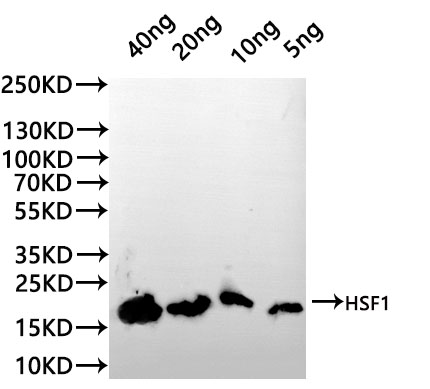 Western Blot
Positive WB detected in: recombinant protein
All lanes:HSF1 Antibody at 1:1000
Secondary
Goat polyclonal to rabbit IgG at 1/20000 dilution
Predicted band size: 20.2 kDa
Observed band size: 22 kDa
Exposure time: 10s.
-
-
其他:
產品詳情
-
產品名稱:Rabbit anti-Saccharomyces cerevisiae (strain ATCC 204508 / S288c) (Baker's yeast) HSF1 Polyclonal antibody
-
Uniprot No.:
-
基因名:
-
別名:Heat shock factor protein (HSF) (Heat shock transcription factor) (HSTF) HSF1 YGL073W
-
宿主:Rabbit
-
反應種屬:Saccharomyces cerevisiae (strain ATCC 204508 / S288c) (Baker's yeast)
-
免疫原:Recombinant Saccharomyces cerevisiae (strain ATCC 204508 / S288c) (Baker's yeast) HSF1 protein (166-276aa )
-
免疫原種屬:Saccharomyces cerevisiae (strain ATCC 204508 / S288c) (Baker's yeast)
-
標記方式:Non-conjugated
-
克隆類型:Polyclonal
-
抗體亞型:IgG
-
純化方式:Antigen Affinity Purified
-
濃度:It differs from different batches. Please contact us to confirm it.
-
保存緩沖液:Preservative: 0.03% Proclin 300
Constituents: 50% Glycerol, 0.01M PBS, pH 7.4 -
產品提供形式:Liquid
-
應用范圍:ELISA, WB
-
推薦稀釋比:
Application Recommended Dilution WB 1:500-1:5000 -
Protocols:
-
儲存條件:Upon receipt, store at -20°C or -80°C. Avoid repeated freeze.
-
貨期:Basically, we can dispatch the products out in 1-3 working days after receiving your orders. Delivery time maybe differs from different purchasing way or location, please kindly consult your local distributors for specific delivery time.
-
用途:For Research Use Only. Not for use in diagnostic or therapeutic procedures.
產品評價

相關產品
靶點詳情
-
功能:DNA-binding transcription factor that specifically binds heat shock promoter elements (HSE) and activates transcription.
-
基因功能參考文獻:
- we show here that a predicted low-complexity interacting region in the disordered C-terminus of the stress response master regulator heat shock factor 1 (Hsf1) protein corresponds to a cryptic amyloid region able to self-assemble into fibrillary structures resembling those found in neurodegenerative disorders PMID: 29734798
- Here the authors show that in budding yeast, Hsf1 basally associates with the chaperone Hsp70 and this association is transiently disrupted by heat shock, providing the first evidence that a chaperone repressor directly regulates Hsf1 activity. PMID: 27831465
- Yeast chaperone gene expression is an essential housekeeping mechanism and provides a roadmap for defining the function of HSF1 as a driver of oncogenesis. PMID: 27320198
- A characteristic residence time for non-specific interactions of HSF1 transcription factor with chromatin PMID: 27566148
- Studies suggest that heat shock factor 1 (Hsf1) controls a set of chaperone protein genes devoted to restoring protein-folding homeostasis in heat shock response. PMID: 27502399
- regulation of Hsf1-Skn7 activities by the catalytic subunits of PKA PMID: 26209979
- finding show that regulation of the Hsf1 S608 phosphorylation status by reciprocal actions of CK2 and Ppt1 might play an important role to determine Hsf1 sensitivity towards ethanol stress PMID: 24894977
- Data indicate that rapamycin inhibition of heat shock transcription factor (Hsf1) can be lost through Hsp90 heat shock protein mutation PMID: 24970820
- Rim15 induces expression of Hsf1 target genes upon glucose depletion by both transcriptional activation and stabilization of the transcripts. PMID: 24140345
- Mediator recruitment to heat shock genes requires dual Hsf1 activation domains and mediator tail subunits Med15 and Med16. PMID: 23447536
- Taken together, these data demonstrate that hyperphosphorylation of Hsf1p caused by loss of the PPT1 gene at least partly accounts for the defective stress response and high ethanol productivity of modern sake yeast strains. PMID: 22057870
- Hsf1 is a key transcription factor of HSP90 and mitochondrial HSP genes. Expression of these target genes is necessary for resistance to proteotoxic stress. Hsf1 regulates longevity through mechanisms that are separate from Rim15. PMID: 21827755
- Carboxy-terminal region of the yeast heat shock factor contains two domains that mediates Kin28-independent transcription. PMID: 14750950
- changes in S. cerevisiae HSF1 transcriptional activity in response to stress might be linked to the combined effects of trehalose and elevated temperatures in modifying the overall structure of HSF1's C-terminal activation domain PMID: 15651035
- findings establish the importance of HSF in prion initiation and strain determination and imply a similar regulatory role of mammalian HSFs in the complex etiology of prion disease PMID: 16452152
- activates expression of PDR3, encoding a multidrug resistance (MDR) transcription factor that also directly activates RPN4 gene expression. PMID: 16556235
- expression of stress proteins are mediated by Rsp5 and that Rsp5 primarily regulates post-translational modification of Hsf1 and Msn4 PMID: 16713599
- These in vivo results support a new role for trehalose, where trehalose directly modifies the dynamic range of Hsf1 activity and therefore influences heat shock protein mRNA levels in response to stress. PMID: 17145780
- The levels of Hsp90 expression affecting transcription factor regulation by Hsp90 client protein kinases also provides a mechanistic model for how heat shock factor can influence the expression of several non-hsp genes in higher organisms. PMID: 17293484
- in response to environmental stresses, Rsp5 primarily regulates the expression of Hsf1 and Msn2/4 at the post-transcriptional level and is involved in the repair system of stress-induced abnormal proteins PMID: 18233954
- activated Hsf1 inhibits rapamycin resistance and TOR signaling via elevated expression of specific target genes PMID: 18270585
- Hsf1 and Msn2/4 act differentially before and after exposure to extreme temperatures to ensure cell survival and growth. PMID: 18359875
顯示更多
收起更多
-
亞細胞定位:Nucleus.
-
蛋白家族:HSF family
-
數據庫鏈接:
KEGG: sce:YGL073W
STRING: 4932.YGL073W
Most popular with customers
-
-
YWHAB Recombinant Monoclonal Antibody
Applications: ELISA, WB, IHC, IF, FC
Species Reactivity: Human, Mouse, Rat
-
-
-
-
-
-