-
中文名稱:CTNNBIP1 Recombinant Monoclonal Antibody
-
貨號:CSB-RA051749A0HU
-
規格:¥1320
-
圖片:
-
 Western Blot
Positive WB detected in:HepG2 whole cell lysate(30μg), A431 whole cell lysate(30μg), MCF7 whole cell lysate(30μg), SH-SY5Y whole cell lysate(30μg), PC-3 whole cell lysate(30μg)
All lanes: beta Catenin interacting protein 1 antibody at 1:1000
Secondary
Goat polyclonal to rabbit IgG at 1/40000 dilution
Predicted band size: 12 kDa
Observed band size: 12 kDa
Exposure time:2min -
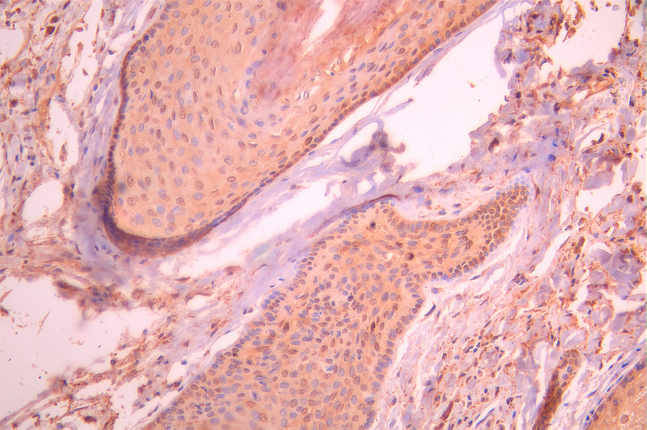 IHC image of CSB-RA051749A0HU diluted at 1:100 and staining in paraffin-embedded human skin tissue performed on a Leica BondTM system. After dewaxing and hydration, antigen retrieval was mediated by high pressure in a citrate buffer (pH 6.0). Section was blocked with 10% normal goat serum 30min at RT. Then primary antibody (1% BSA) was incubated at 4°C overnight. The primary is detected by a Goat anti-rabbit polymer IgG labeled by HRP and visualized using 0.05% DAB.
 -
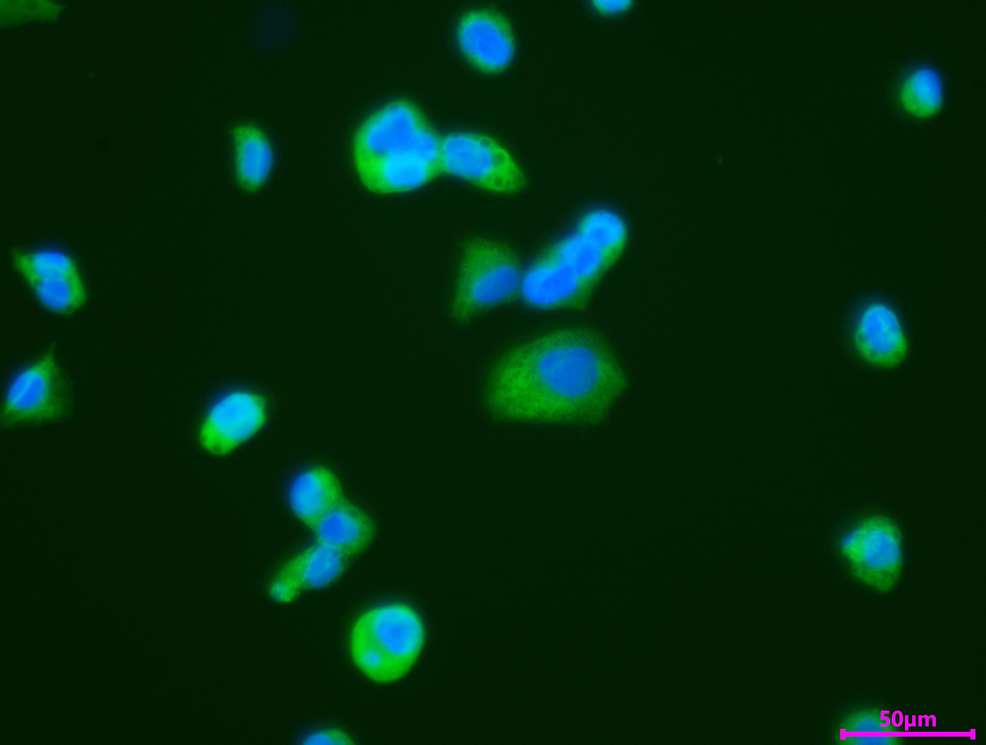 Immunofluorescence staining of Hep-G2 cell with CSB-RA051749A0HU at 1:50 ,counter-stained with DAPI. The cells were fixed in 4% formaldehyde, permeabilized using 0.2% Triton X-100 and blocked in 10% normal Goat Serum. The cells were then incubated with the antibody overnight at 4°C. The secondary antibody was Alexa Fluor 488-congugated AffiniPure Goat Anti-Rabbit IgG(H+L).
-
-
其他:
產品詳情
-
Uniprot No.:
-
基因名:
-
別名:Beta-catenin-interacting protein 1 (Inhibitor of beta-catenin and Tcf-4), CTNNBIP1, ICAT
-
反應種屬:Human
-
免疫原:A synthesized peptide derived from Human CTNNBIP1 protein
-
免疫原種屬:Homo sapiens (Human)
-
標記方式:Non-conjugated
-
克隆類型:Monoclonal
-
抗體亞型:Rabbit IgG
-
純化方式:Affinity-chromatography
-
克隆號:9A10
-
濃度:It differs from different batches. Please contact us to confirm it.
-
保存緩沖液:Rabbit IgG in 10mM phosphate buffered saline , pH 7.4, 150mM sodium chloride, 0.05% BSA, 0.02% sodium azide and 50% glycerol.
-
產品提供形式:Liquid
-
應用范圍:ELISA, WB, IHC, IF
-
推薦稀釋比:
Application Recommended Dilution WB 1:500-1:5000 IHC 1:50-1:200 IF 1:20-1:200 -
Protocols:
-
儲存條件:Upon receipt, store at -20°C or -80°C. Avoid repeated freeze.
-
貨期:Basically, we can dispatch the products out in 1-3 working days after receiving your orders. Delivery time maybe differs from different purchasing way or location, please kindly consult your local distributors for specific delivery time.
-
用途:For Research Use Only. Not for use in diagnostic or therapeutic procedures.
產品評價

相關產品
靶點詳情
-
功能:Prevents the interaction between CTNNB1 and TCF family members, and acts as negative regulator of the Wnt signaling pathway.
-
基因功能參考文獻:
- Data demonstrated that ICAT was highly expressed in cervical cancer tissues and had a role in control of epithelial-mesenchymal transition (EMT) in cervical cancer cells. Its overexpression promoted cell proliferation, migration, invasion and resulted in EMT by disrupting the stability of E-cadherin/betacatenin complex. PMID: 29048651
- Low PLD1 expression and high ICAT expression were significantly associated with increased survival in colorectal cancer patients. PMID: 28939743
- The present work aims to investigate the relationship between the expression of AEG-1(astrocyte elevated gene-1), b-FGF(basic-fibroblast growth factor), beta-catenin, Ki-67, TNF-alpha (tumor necrosis factor-alfa) other prognostic parameters in DC (Ductal Carcinomas) and ductal intraepithelial neoplasm. We found a relationship between these factors. PMID: 26096243
- Overexpression of ICAT promoted Caski cells' proliferation, arrested the cell cycle in the S phase and enhanced cell migration. Conclusion Overexpression of ICAT can promote the proliferation and migration of Caski cervical cancer cells. PMID: 27774943
- Somatic mutation of beta-catenin (CTNNB1) is known to be crucial for Wilms tumor development in up to 15% of cases. PMID: 27679509
- CTNNBIP1 expression correlated with longer overall survival in LAC patients. This study reveals that miR-214 plays a critical role in CSLC self-renewal and stemness by targeting CTNNBIP1. PMID: 26299367
- Data show that microRNA miR-215 activates beta-catenin pathways by decreasing catenin beta interacting protein 1 (CTNNBIP1)expression in gliomas. PMID: 26317904
- Simultaneous silencing of beta-catenin and STAT3 synergistically induces apoptosis and inhibits cell proliferation in HepG2 liver cancer cells. PMID: 25845340
- Finally, pro-incubation with idebenone inhibited mitochondrial dysfunction induced by oxLDL through the mitochondrial-dependent apoptotic pathway and GSK3beta/beta-catenin signalling pathways. PMID: 26284974
- A potent beta-catenin inhibitor, ICAT/CTNNBIP1 was a direct target of miR-424-5p. PMID: 25175916
- Particulate matter (PM10) downregulates E-Cadherin/beta-Catenin expression. PMID: 26047787
- A statistically significant lapatinib- and gefitinib-induced repression of cyclin D1, MMP9 and beta-catenin in CERV196 cells. PMID: 26124325
- Nuclear YAP and cytoplasmic beta-catenin play important roles in carcinogenesis. PMID: 26124339
- review of control of cell fate and proliferation in colon cancer PMID: 25193262
- miR-603 regulates glioma development via Wnt-beta-cateninn signaling pathway and its WIF1 and CTNNBIP1 targets. PMID: 25681036
- These results indicate that beta-catenin translation is initiated via the IRES and this is regulated by PTX, suggesting that regulation of the IRES-dependent translation of beta-catenin may be involved in the cancer cell response to PTX treatment. PMID: 25849888
- ICAT may serve as a tumor-suppressor in human glioma. PMID: 25434796
- Suppressing TrpC5 expression decreased nuclear beta-catenin accumulation, reduced the induction of ABCB1, and reversed 5-fluorouracil neoplastic resistance. PMID: 25404731
- Our results indicate that HDAC1 plays an important role in chondrogenesis and may represent a therapeutic target for modulation of cartilage development. PMID: 25445594
- ASPP2 prevents beta-catenin from transactivating ZEB1 directly by forming an ASPP2-beta-catenin-E-cadherin ternary complex PMID: 25344754
- It involved in the control of cell growth, differentiation, and apoptosis. PMID: 24390805
- PTHrP was found to inhibit DKK1 expression through c-Jun-mediated inhibition of beta-catenin activity on the DKK1 promoter. PMID: 23752183
- beta-catenin inhibitor ICAT modulates the invasive motility of melanoma cells. PMID: 24514042
- Neither cyclin D1 nor beta-catenin was expressed in a statistically significant manner, concluding that the development of MCCs is independent of beta-catenin and cyclin D1 expression and these proteins are not suitable as prognostic markers. PMID: 23928935
- beta-catenin is delocalized and survivin is over-expressed in recurrent sporadic and nevoid basal cell carcinoma syndrome-associated keratocystic odontogenic tumor PMID: 23572266
- Thus, our results indicated abnormal expression of CD44V6, CDH11, and beta-catenin in osteosarcomas and osteochondromas, which may provide important indicators for further research. PMID: 23971040
- The data show that Snail1 and beta-catenin, besides association with loss of hormone dependence, protect cancer cells from hypoxia and may serve as an important target in the treatment of breast cancer. PMID: 23973669
- This study demonistrated that mean protein and mRNA levels of beta-catenin were significantly decreased in both the PFC and hippocampus of teenage suicide group compared to controls. PMID: 23110823
- beta-catenin accumulation in the nucleus regulates expression of Nanog protein and has a role in progression of non-small cell lung cancer PMID: 23648139
- These findings suggest that Sphingosine-1-phosphate activates signaling leading to nuclear translocation of beta-catenin in osteoblast-like cells and upregulation of osteoptotegerin and osteoblast differentiation markers PMID: 23612487
- beta-catenin was significantly associated with nodal stage, TNM stage, and E-cadherin expression. beta-catenin could be early marker for identification of occult metastases in oral SCC. PMID: 22525043
- In this review, we will discuss the points of intersection between the Wnt/beta-catenin and Hippo/YAP pathways and how these interactions contribute to homeostasis, organ repair, and tumorigenesis. PMID: 23027379
- ICAT is a novel Ptf1a interactor that regulates pancreatic acinar differentiation and displays altered expression. PMID: 23339455
- our data clearly identify protein stabilizing mutations of the beta-catenin gene as a common feature of nested stromal epithelial tumors of the liver, similarly as in hepatoblastomas. PMID: 22749188
- Microatellite-stable cases exhibited reduced membranous beta catenin and increased cytoplasmic and nuclear beta catenin compared with microsatellite-instable cases. PMID: 21791486
- Airway basal cell beta-catenin determines cell fate and its mis-expression is associated with the development of human lung cancer. PMID: 22081448
- Cholangiocarcinoma cell lines express E-cad and beta-cat but with different localizat- ion patterns. PMID: 22075503
- Inhibitor of beta-catenin and T-cell factor (ICAT), a beta-catenin binding protein that inhibits the canonical Wnt/beta-catenin signaling pathway, in AR signaling, was investigated. PMID: 21885566
- Reduced/aberrant beta-catenin expression was seen in benign and malignant salivary gland tumors. PMID: 20034989
- ICAT is a direct transcriptional target of E2F1, and activation of ICAT by E2F1 is required for E2F1 to inhibit beta-catenin activity. PMID: 21532622
- overexpression of beta-catenin may be an important contributing factor to glioma progression. PMID: 20300972
- High beta-catenin is associated with glioma progression. PMID: 21636708
- LMP1 may be involved in nasopharyngeal carcinogenesis via beta-catenin signaling pathway PMID: 21336584
- A coactivator role of CARM1 in the dysregulation of beta-catenin activity in colorectal cancer cell growth and gene expression PMID: 21478268
- When both E-cadherin and beta -catenin expressions were reduced, there was a significant unfavourable prognosis. PMID: 21574102
- The protein expression levels of Wnt1, beta-catenin and Cyclin D1 were all positively correlated with the Karnofsky performance scale (KPS) score and World Health Organization (WHO) grades of patients with gliomas. PMID: 20809334
- beta-catenin is expressed in actinic chelitis and squamous cell carcinoma of the lip PMID: 20970365
- Data show that elevated beta-catenin expression level may be an adverse indicator for the prognosis of ESCC patients at stage T2-3N0M0, especially for those with T3 lesions or stage IIB diseases. PMID: 21049553
- cytoplasmic accumulation of beta-catenin can induce Tcf/Lef-mediated transcriptional activity, up-regulate MMP-7, and induce epithelial and mesenchymal transition (EMT). PMID: 20878057
- our results support the concept that STAT3 upregulates the protein expression and transcriptional activity of beta-catenin in breast cancer. PMID: 20830236
顯示更多
收起更多
-
亞細胞定位:Cytoplasm. Nucleus.
-
蛋白家族:CTNNBIP1 family
-
數據庫鏈接:
Most popular with customers
-
-
YWHAB Recombinant Monoclonal Antibody
Applications: ELISA, WB, IHC, IF, FC
Species Reactivity: Human, Mouse, Rat
-
Phospho-YAP1 (S127) Recombinant Monoclonal Antibody
Applications: ELISA, WB, IHC
Species Reactivity: Human
-
-
-
-
-