KRT9 Recombinant Monoclonal Antibody
-
中文名稱:KRT9 Recombinant Monoclonal Antibody
-
貨號:CSB-RA182472A0HU
-
規(guī)格:¥1320
-
圖片:
-
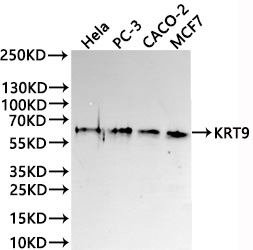 Western Blot
Positive WB detected in: Hela whole cell lysate(30μg), PC-3 whole cell lysate(30μg), CACO-2 whole cell lysate(30μg), MCF7 whole cell lysate(30μg)
All lanes: KRT9 antibody at 1:1000
Secondary
Goat polyclonal to rabbit IgG at 1/40000 dilution
Predicted band size: 62 kDa
Observed band size: 62 kDa
Exposure time:2min
-
-
其他:
產(chǎn)品詳情
-
Uniprot No.:
-
基因名:
-
別名:Keratin, type I cytoskeletal 9 (Cytokeratin-9) (CK-9) (Keratin-9) (K9), KRT9
-
反應(yīng)種屬:Human
-
免疫原:A synthesized peptide derived from Human KRT9 protein
-
免疫原種屬:Homo sapiens (Human)
-
標(biāo)記方式:Non-conjugated
-
克隆類型:Monoclonal
-
抗體亞型:Rabbit IgG
-
純化方式:Affinity-chromatography
-
克隆號:6G7
-
濃度:It differs from different batches. Please contact us to confirm it.
-
保存緩沖液:Rabbit IgG in 10mM phosphate buffered saline , pH 7.4, 150mM sodium chloride, 0.05% BSA, 0.02% sodium azide and 50% glycerol.
-
產(chǎn)品提供形式:Liquid
-
應(yīng)用范圍:ELISA, WB
-
推薦稀釋比:
Application Recommended Dilution WB 1:500-1:5000 -
Protocols:
-
儲存條件:Upon receipt, store at -20°C or -80°C. Avoid repeated freeze.
-
貨期:Basically, we can dispatch the products out in 1-3 working days after receiving your orders. Delivery time maybe differs from different purchasing way or location, please kindly consult your local distributors for specific delivery time.
-
用途:For Research Use Only. Not for use in diagnostic or therapeutic procedures.
產(chǎn)品評價

相關(guān)產(chǎn)品
靶點(diǎn)詳情
-
功能:May serve an important special function either in the mature palmar and plantar skin tissue or in the morphogenetic program of the formation of these tissues. Plays a role in keratin filament assembly.
-
基因功能參考文獻(xiàn):
- A novel heterozygous c.1369C>T transition (p.Leu457Phe) in exon 6 of the KRT9 gene was identified in four patients in a Chinese Family with Epidermolytic Palmoplantar Keratoderma. PMID: 29719290
- During analyzing the sequences of KRT9 gene of a epidermolytic palmoplantar keratoderma (EPPK) pedigree, we found a new heterozygous missense mutation (488G>T) of exon 1 of KRT9 gene, which has not been reported before and does not exist in healthy individuals of the family and 100 unrelated individuals. PMID: 27726289
- Results identified the missense mutation KRT9 c.487C>T, as a potential causative mutation in the large Uygur family with epidermolytic palmoplantar keratoderma. PMID: 27864007
- KRT9 expression is significantly downregulated in human masticatory mucosa during wound healing PMID: 28005267
- Findings suggest that dysregulated Keratin 9 expression is a consequence of Alzheimer's disease (AD). PMID: 26973255
- Mutational analysis revealed a T to G transition in the coding DNA sequence, designated as c.470T>G (p.Met157Arg), a missense mutation in exon 1 of KRT9 in the proband and her brother, but not in unrelated healthy controls. PMID: 24899405
- KRT9 gene mutation as a reliable indicator in the prenatal molecular diagnosis of epidermolytic palmoplantar keratoderma. PMID: 24862219
- A heterozygous missense mutation c.482A to G in the KRT9 gene. PMID: 24510562
- Our findings indicate that knuckle pads can be associated with epidermolytic palmoplantar keratoderma and the R163W mutation in a family with a genetic background different from that described here. PMID: 23278372
- We identified a novel Eidermolytic Palmoplantar Keratoderma-causing mutation located in a region of the KRT9 gene, encoding a poorly conserved region of the protein that is not routinely screened for diagnostic purposes. PMID: 23397986
- Data indicate that the node tumour burden could be accurately quantified based on the cytokeratin 19 (CK19) mRNA copy number. PMID: 23265708
- A heterozygous transversional mutation, 488G-->A, was identified in exon 1 of KRT9 gene in all patients. PMID: 22678789
- A substitution in arginine alters the charge and shape of KRT9 rod domain, disrupting the function of the helix initiation motif of keratins and compromising the integrity of filaments and weakening their stability in the epidermis of palms and soles. PMID: 22262370
- KRT9 may play a complicated role in the genesis of epidermolytic palmoplantar keratoderma with knuckle pads and camptodactyly. PMID: 21715251
- Study provides evidence that epidermolytic palmoplantar keratoderma in a large Chinese family may result from a novel duplication mutation (c.495_503dupCTCTTACTT) in the 1A rod domain of KRT9. PMID: 21489919
- identified mRNA transcripts from three genes CDSN, LOR and KRT9, showing strong over-expression in skin samples relative to samples from forensic body fluids, making them suitable markers for skin identification PMID: 21221983
- A c.T1206C substitution in the 2B domain of KRT 9 was identified. PMID: 20964665
- The affected members of all five families possess mutations in the KRT9 gene that severely affect heterodimer formation with the type II keratin partner. PMID: 19874353
- Genetic studies have revealed that K9 gene mutations are responsible for epodermolytic palmoplantar keratoderma. PMID: 12532041
- Keratin 9 is mutated in epidermolytic palmoplantar keratoderma PMID: 14675368
- Keratin 9 gene mutation is associated with diffuse palmoplantar keratoderma. PMID: 16043929
- A heterozygous nucleotide T-->C transition at position 500 in exon 1 of KRT9 was detected, which resulted in a leucine to serine (L167S) change. PMID: 17362238
- A missense mutation in keratin 9 -- Met157Arg in the 1A domain -- was found in a Chinese family with EPPK PMID: 18477167
- the first family from Northeast China affected by epidermolytic palmoplantar keratoderma (EPPK) in which we confirmed the presence of the N161S mutation as the result of a 548A>G transition in exon1 of the keratin 9 gene. PMID: 18573708
- We show that in a family affected by EPPK and knuckle pad keratosis, carrying the R163W substitution, wild type (wt) and mutated K9 are strongly expressed in knuckle pads. This suggests that the knuckle pad phenotype is due to ectopical expression of K9. PMID: 19106041
- The genomic DNA from the patient's peripheral blood showed an R162W mutation in the keratin 9 gene. We therefore diagnosed the patient with Vorner type EPPK. PMID: 19451521
- Prenatal diagnosis of epidermolytic palmoplantar keratoderma caused by c.T470C (p.M157T) of the keratin 9 gene. PMID: 19548225
顯示更多
收起更多
-
相關(guān)疾病:Keratoderma, palmoplantar, epidermolytic (EPPK)
-
蛋白家族:Intermediate filament family
-
組織特異性:Expressed in the terminally differentiated epidermis of palms and soles.
-
數(shù)據(jù)庫鏈接:
Most popular with customers
-
-
YWHAB Recombinant Monoclonal Antibody
Applications: ELISA, WB, IHC, IF, FC
Species Reactivity: Human, Mouse, Rat
-
Phospho-YAP1 (S127) Recombinant Monoclonal Antibody
Applications: ELISA, WB, IHC
Species Reactivity: Human
-
-
-
-
-