-
中文名稱:PICK1 Recombinant Monoclonal Antibody
-
貨號:CSB-RA047352A0HU
-
規格:¥1320
-
圖片:
-
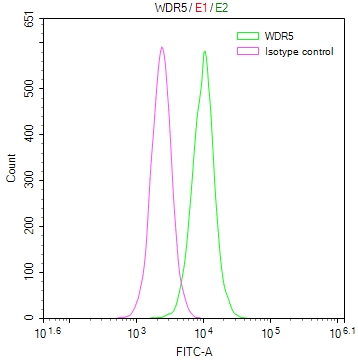
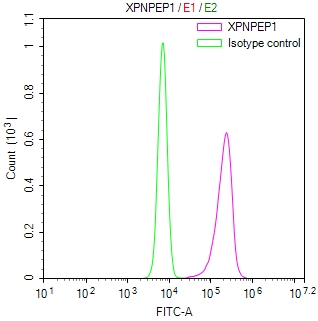
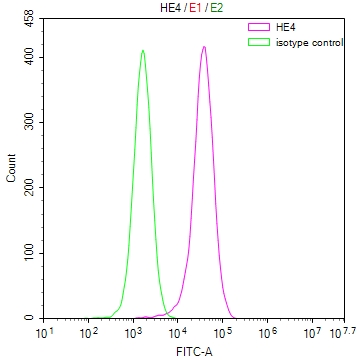
 Overlay Peak curve showing PC-3 cells stained with CSB-RA047352A0HU (red line) at 1:100. The cells were fixed in 4% formaldehyde and permeated by 0.2% TritonX-100 for?10min. Then 10% normal goat serum to block non-specific protein-protein interactions followed by the antibody (1ug/1*106cells) for 45min at 4℃. The secondary antibody used was FITC-conjugated goat anti-rabbit IgG (H+L) at 1/200 dilution for 35min at 4℃.Control antibody (green line) was Rabbit IgG (1ug/1*106cells) used under the same conditions. Acquisition of >10,000 events was performed.
-
-
其他:
產品詳情
-
Uniprot No.:
-
基因名:
-
別名:PRKCA-binding protein (Protein interacting with C kinase 1) (Protein kinase C-alpha-binding protein), PICK1, PRKCABP
-
反應種屬:Human
-
免疫原:A synthesized peptide derived from Human PICK1 protein
-
免疫原種屬:Homo sapiens (Human)
-
標記方式:Non-conjugated
-
克隆類型:Monoclonal
-
抗體亞型:Rabbit IgG
-
純化方式:Affinity-chromatography
-
克隆號:5D5
-
濃度:It differs from different batches. Please contact us to confirm it.
-
保存緩沖液:Rabbit IgG in 10mM phosphate buffered saline , pH 7.4, 150mM sodium chloride, 0.05% BSA, 0.02% sodium azide and 50% glycerol.
-
產品提供形式:Liquid
-
應用范圍:ELISA, FC
-
推薦稀釋比:
Application Recommended Dilution FC 1:20-1:200 -
Protocols:
-
儲存條件:Upon receipt, store at -20°C or -80°C. Avoid repeated freeze.
-
貨期:Basically, we can dispatch the products out in 1-3 working days after receiving your orders. Delivery time maybe differs from different purchasing way or location, please kindly consult your local distributors for specific delivery time.
-
用途:For Research Use Only. Not for use in diagnostic or therapeutic procedures.
產品評價

相關產品
靶點詳情
-
功能:Probable adapter protein that bind to and organize the subcellular localization of a variety of membrane proteins containing some PDZ recognition sequence. Involved in the clustering of various receptors, possibly by acting at the receptor internalization level. Plays a role in synaptic plasticity by regulating the trafficking and internalization of AMPA receptors. May be regulated upon PRKCA activation. May regulate ASIC1/ASIC3 channel. Regulates actin polymerization by inhibiting the actin-nucleating activity of the Arp2/3 complex; the function is competetive with nucleation promoting factors and is linked to neuronal morphology regulation and AMPA receptor (AMPAR) endocytosis. Via interaction with the Arp2/3 complex involved in regulation of synaptic plasicity of excitatory synapses and required for spine shrinkage during long-term depression (LTD). Involved in regulation of astrocyte morphology, antagonistic to Arp2/3 complex activator WASL/N-WASP function.
-
基因功能參考文獻:
- this is the first study to indicate that PICK1 polymorphisms may associate with cognitive functions in schizophrenic patients. PMID: 28507309
- Coincident with the loss of PICK1 by GBF1-activated ARF1, CDC42 recruitment leads to the activation of IRSp53 and the ARP2/3 complex, resulting in a burst of F-actin polymerisation potentially powering scission. PMID: 29743604
- PICK1 is a cargo-specific endocytic accessory protein required for efficient, activity-dependent AMPAR endocytosis. PMID: 28855251
- Our results demonstrate that downregulation of PICK1 elicited by miR-210-3p overexpression activates the TGF-b pathway, which further promotes bone metastasis in PCa, indicating that the miR- 210-3p/PICK1/TGF-b signalling axis plays an important role in PCa bone metastasis. PMID: 28697177
- This study defines a novel mechanism whereby elevated [Ca(2+)] induced by NMDA receptor activation modulates Ago2 and miRNA activity via PICK1. Our work suggests a Ca(2+)-dependent process to regulate miRNA activity in neurons in response to the induction of long-term depression. PMID: 28404816
- We propose that PICK1 negatively regulates neoplastic infiltration of astrocytic tumors and that manipulation of PICK1 is an attractive possibility for therapeutic intervention PMID: 26466675
- PICK1 domain ACT links PICK1-associated vesicles to a motility factor, likely myosin, but, contrary to previous reports, PICK1 neither binds nor inhibits Arp2/3 complex. PMID: 25657323
- Unlike accessory domains in other BAR domain proteins, the positioning of the PDZ domains is flexible, enabling PICK1 to perform long-range, dynamic scaffolding of membrane-associated proteins. PMID: 26073603
- Data indicate three principal binding modes can account for protein interacting with C-kinase 1 (PICK1) PDZ domains binding specificity. PMID: 25023278
- PICK1 promotes Ago2 localization at endosomal compartments in neuronal dendrites and inhibits Ago2 function in translational repression following neuronal stimulation. PMID: 24723684
- These data indicate that Pick1 is involved in regulating the cell-cell junction in epithelial cells. PMID: 24937449
- C-terminal domain of ICA69 interacts with PICK1 and acts on trafficking of PICK1-PKCalpha complex and cerebellar plasticity. PMID: 24358315
- Family-based association study failed to observe a statistically significant association for any of the genotyped SNPs in the PICK1 gene and attention-deficit hyperactivity disorder. PMID: 22436349
- PICK1 increases caveolin-mediated endocytosis, ubiquitination and degradation of TGF-beta type I receptor. PMID: 22710801
- The binding affinities of all major PICK1 interacting proteins are reported and the effects of PICK1 mutations on these interactions are described. PMID: 22275068
- PICK1 is a suppressor of spinocerebellar ataxia 3-associated neurodegeneration. PMID: 21949352
- Neph proteins and PICK1 synergistically regulate cell recognition and contact formation; Binding required dimerization of PICK1, was dependent on PDZ domain protein interactions, and mediated stabilization of Neph1 at the plasma membrane. PMID: 21690291
- we have identified a homozygous mutation in the PICK1 gene that is associated with globozoospermia in humans PMID: 20562896
- The PICK1 mRNA is elevated in patient with schizophrenia. PMID: 20385472
- Protein interacting with C alpha kinase 1 (PICK1) is involved in promoting tumor growth and correlates with poor prognosis of human breast cancer. PMID: 20384629
- Results describe the first small-molecule inhibitor (FSC231) of the PDZ domain in PICK1, which binds the PICK1 PDZ domain with an affinity similar to that observed for endogenous peptide ligands. PMID: 20018661
- binding with glutamate receptor subtype PMID: 11891216
- The PICK1 rs3952 polymorphism was genotyped in schizophrenia and controls. Results demonstrated that the PICK1 rs3952 genotype and allele distribution was significantly different between the two groups. PMID: 15305146
- PICK-1 could be involved in the regulation of both adherens and tight junctions in epithelial cells PMID: 15811349
- In a case-control association study, an association of the PICK1 gene with schizophrenia (SZ) was seen, which is more prominent in disorganized SZ. Findings implicating PICK1 are consistent with a role for D-serine in the disease. PMID: 16314870
- polymorphisms of the PICK1 gene identified thus far are unlikely to contribute to genetic susceptibility to schizophrenia in the Japanese population PMID: 17367885
- findings suggest that the PICK1 gene may be implicated in the susceptibility to spontaneous relapse of methamphetamine psychosis and that, as an intracellular adapter protein, PICK1 may play a role in the pathophysiology of methamphetamine psycho PMID: 17606663
- PICK1 synaptic targeting requires direct interaction between the PDZ domain and lipid membranes PMID: 17914463
- KRIP6 regulates kainate receptors by inhibiting PICK1 modulation via competition or a mutual blocking effect PMID: 18692513
顯示更多
收起更多
-
亞細胞定位:Cytoplasm, perinuclear region. Membrane; Peripheral membrane protein. Membrane; Lipid-anchor. Cell junction, synapse, postsynaptic density. Cell junction, synapse, synaptosome. Cytoplasm, cytoskeleton.
-
組織特異性:Ubiquitous.
-
數據庫鏈接:
Most popular with customers
-
-
YWHAB Recombinant Monoclonal Antibody
Applications: ELISA, WB, IHC, IF, FC
Species Reactivity: Human, Mouse, Rat
-
Phospho-YAP1 (S127) Recombinant Monoclonal Antibody
Applications: ELISA, WB, IHC
Species Reactivity: Human
-
-
-
-
-